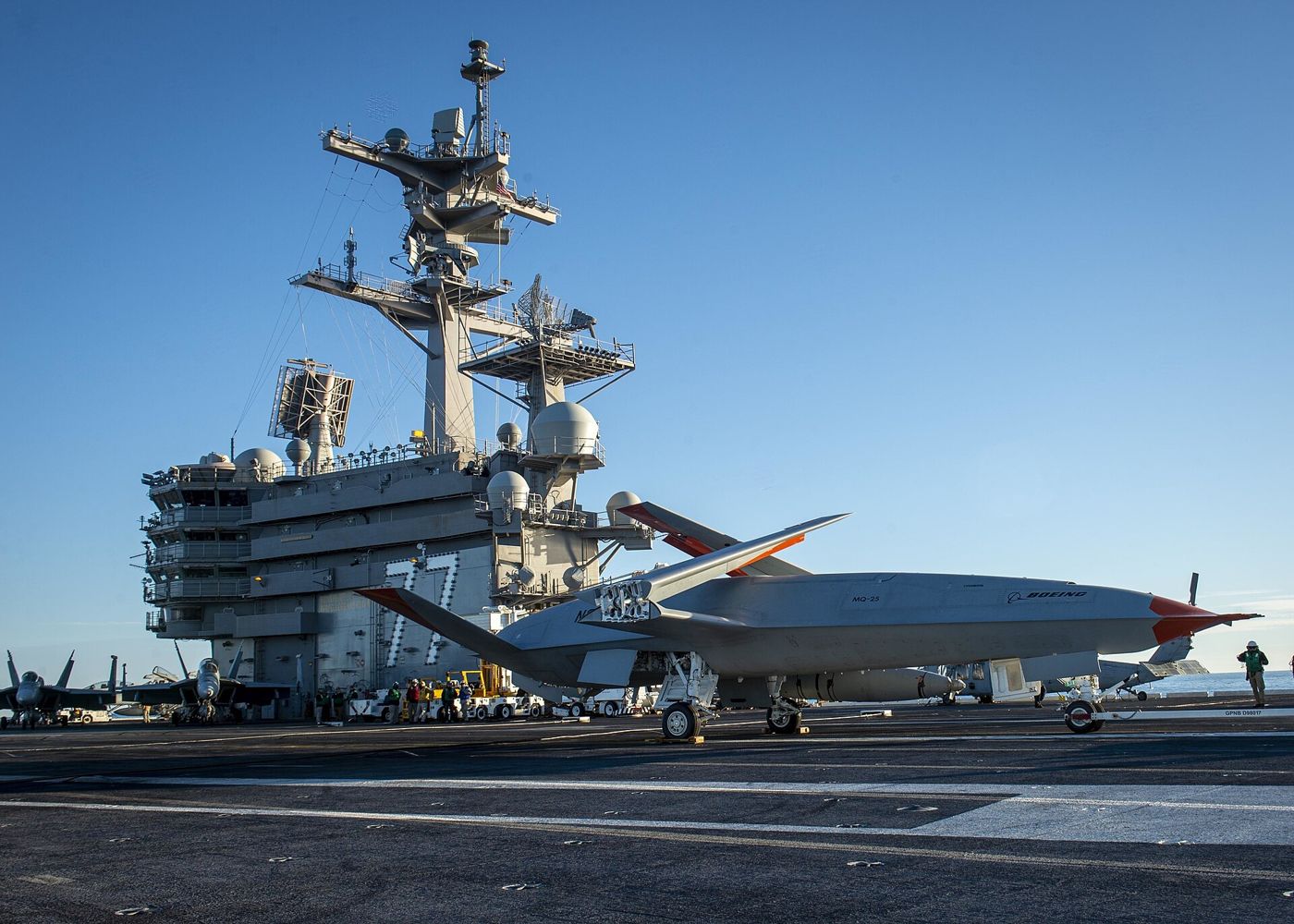
In December 2021 a Boeing-owned test aircraft known as T1 went aboard USS George H.W. Bush and did everything a carrier aircraft does except fly. It taxied, connected to a catapult, cleared the landing area and parked, while a Boeing operator standing beside a Navy flight deck director drove it with a handheld control device, according to Naval News’ account of the demonstration. The production-representative MQ-25A Stingray did not make its first flight until April 25, 2026, and it did so from a runway in Illinois.
On August 31 the Navy issued a request for information for a carrier-based Collaborative Combat Aircraft, and the document assumes the new aircraft will be flown through the MQ-25’s control system by the sailors already in the air wing. The Navy is writing its combat drone requirement on top of carrier infrastructure that the tanker has installed but, on the public record, has not yet exercised with an aircraft at sea. Until the Stingray is flown and controlled from a ship, the hardest parts of the CCA requirement rest on assumption, and the Navy should sequence the two programs accordingly.
The tanker’s schedule leaves little margin
The Stingray was originally due to reach initial operational capability in 2024. The target moved to July 2027 and now sits at February 2029, according to the Navy’s April 2026 acquisition report as described by The War Zone. The Congressional Research Service, in an August 12 update, puts the slip at four years.
Production has not waited for that testing. The Navy approved Milestone C on May 19 and Naval News reported on September 21 that Boeing had received a $562 million contract for three Lot 1 aircraft and advance procurement for three more. The Defense Department inspector general warned in 2023 that making production decisions before developmental and operational testing “increases risk” of delayed deployment to carriers and higher cost. CRS notes that the Government Accountability Office raised the same concern this year.
The at-sea evidence is still to come. The Navy’s stated plan after first flight was to move the aircraft to Naval Air Station Patuxent River by the end of 2026 to prepare for carrier testing. Aviation Today reported in May that a shipboard event planned aboard USS Ronald Reagan in fiscal 2027 is a non-flying risk reduction exercise.
The control station is ahead of the aircraft
The part of the program that has moved fastest is the one CCAs will inherit. The Unmanned Carrier Aviation Mission Control System, designated MD-5, is described by CRS as the planned control station for the MQ-25 “as well as potentially for future UAVs.” The first shipboard control room went into George H.W. Bush in 2024. The April acquisition report, as quoted by The War Zone, says USS Theodore Roosevelt became the “first fully operational/deployable MQ-25 capable aircraft carrier” in March 2026, with Ronald Reagan planned to follow at the end of August.
What has been demonstrated is narrower than what has been installed. In November 2024 Navy air vehicle pilots at Patuxent River used an MD-5 station to command a General Atomics MQ-20 Avenger flying in California over a low Earth orbit satellite link. The station first connected to an MQ-25A in October 2025 and controlled the April first flight. A network evaluation with USS Abraham Lincoln passed traffic between a carrier and an MQ-25 surrogate. Lockheed Martin says its software will let a single carrier-based station control multiple uncrewed vehicles. That is a vendor’s claim about the future. The reported tests so far have involved shore stations, surrogates or network traffic, and none of the public accounts reviewed for this article describes a shipboard crew controlling a carrier-launched aircraft and passing it to another station.
The CCA request assumes answers the tanker has not produced
The August request is ambitious on the airframe. It seeks two prototypes capable of “shore-based, aircraft carrier qualifications” within three years, carrying four external weapons of up to 2,500 pounds each and able to make catapult launches and arrested landings up to Sea State 5. The cost target is about $30 million per aircraft, roughly double the figure discussed in 2024. The War Zone reports that the Navy wants a first flight within 24 months of contract award.
The harder requirements are the ones a runway never imposes. A carrier aircraft is moved within feet of other aircraft and people, onto a catapult and out of the landing area, on a ship that may be restricting its own radio emissions to avoid detection. The Navy’s request asks industry for a deck handling system that can operate all carrier-based uncrewed aircraft “through launch, recovery and deck operations during EMCON” conditions, the Navy’s shorthand for emissions control, without added support equipment or flight deck personnel. Any controller that depends on a radio link to the aircraft is in tension with that goal. The War Zone noted in August that it is “still unclear” what the Navy will use to move operational MQ-25s around the deck.
The Navy’s decision to reuse MD-5, the existing air wing and existing deck procedures for CCA is sound. The sequencing is the weakness. CCA prototype awards should be tied to two MQ-25 results: a selected deck handling method that has been shown to work under emissions control, and a shipboard MD-5 crew controlling an aircraft through launch, handoff and recovery. CRS already asks what lessons the Stingray holds for other carrier-based uncrewed aircraft. Congress can make that question binding by requiring the Navy to report those two results before it commits to carrier qualification dates for a combat drone.
This analysis draws on the public sources linked in the text. Send corrections to [email protected].